

Zwerger, Klaus
Wood and Wood Joints: Building Traditions of Europe and Japan
Wood and Wood Joints: Building Traditions of Europe and Japan
Couldn't load pickup availability
Basel, Switzerland: Birkhauser, 1997. First ed., first printing (full number line). Quarto with black boards in black and white pictorial jacket; light yellow endpapers; 278 pages: illustrations; index; 31 cm Near fine in near fine(-) jacket, now in archival mylar. Hardcover. ISBN: 3764354836
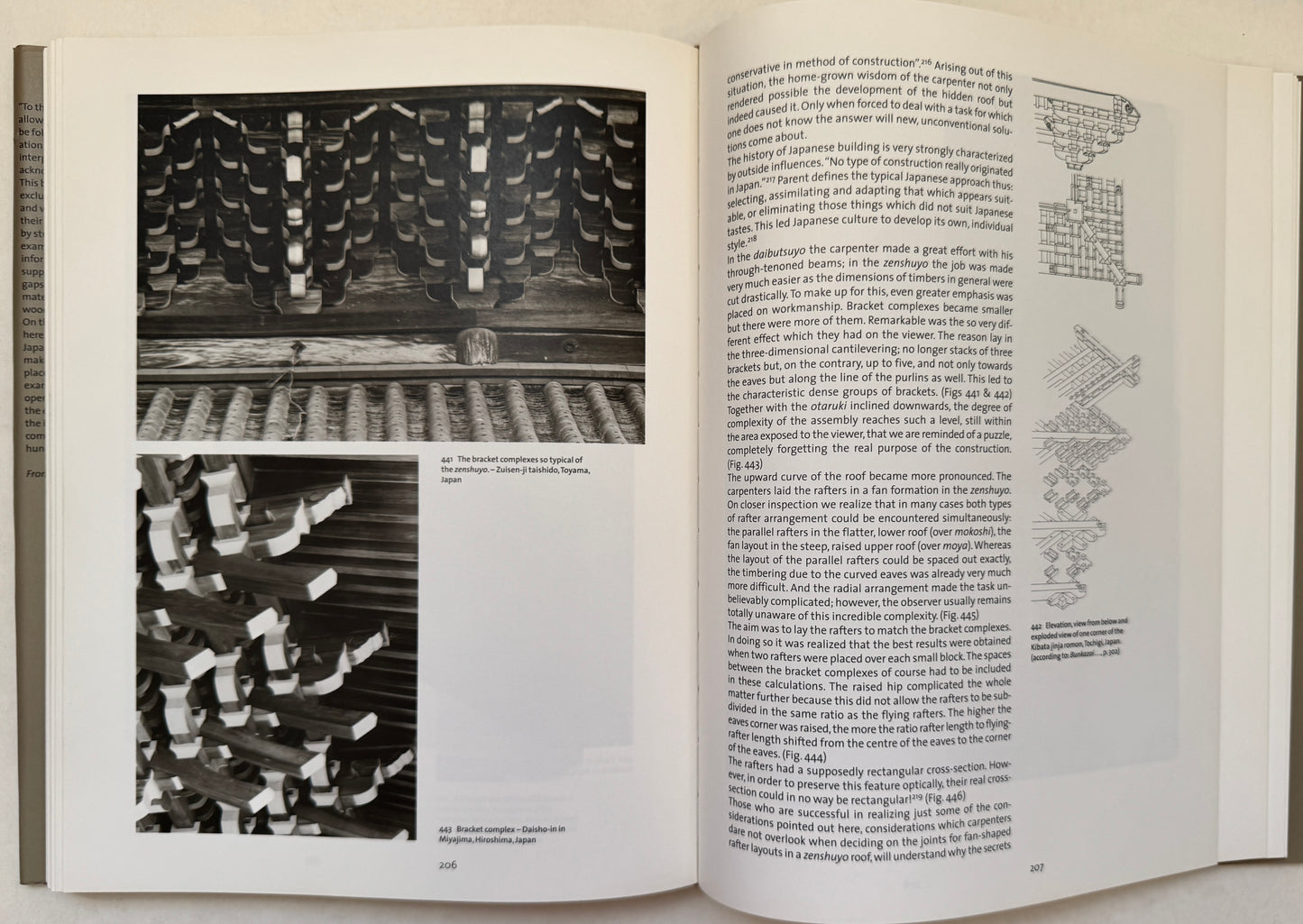
"In the most typical method of building with wood, elements are connected by using wood joints which do not require the assistance of adhesives or metal connectors. This art of wood jointing reached its zenith in Japan; but Europe too provided its share of highly influential forms. By looking at several hundred examples from Japan and 18 European countries, this book describes in great detail the history of timber architecture in terms of its technical, aesthetic and ecological dimensions. The beauty of timber structures and their detailing is captured in superb black-and-white photographs. Exciting three-dimensional drawings reveal the secret life concealed within the joints. This thorough study will prove a mine of information to specialists in this field; it will open up to the craftsman of today what has become an almost forgotten world and provide a fascinating account for the general reader." --Back cover. Translated from German. //
Contents: [Pt. 1] The material. The properties of wood. Species of wood. [Pt. 2] Working with wood. Uses. The carpenter. The carpenter's tools. Forms of construction. [Pt. 3] Types and functions of wood joints. Typology. Classification systems in the literature. Limits to the classification systems. The functions of wood joints. [Pt. 4] Wood joints and their evolution. The role of the tool. Building tasks and their solutions. Log construction. Column-and-beam construction. Roof construction. The influence of climatic conditions. Abundance and scarcety of timber. [Pt. 5] Wood joints as an expression of aesthetic values. The visible and the invisible. Protection and prestige. Construction and decoration. // **Somewhat heavy item. Additional shipping fees may be needed for expedited or international orders. Please inquire**
Share