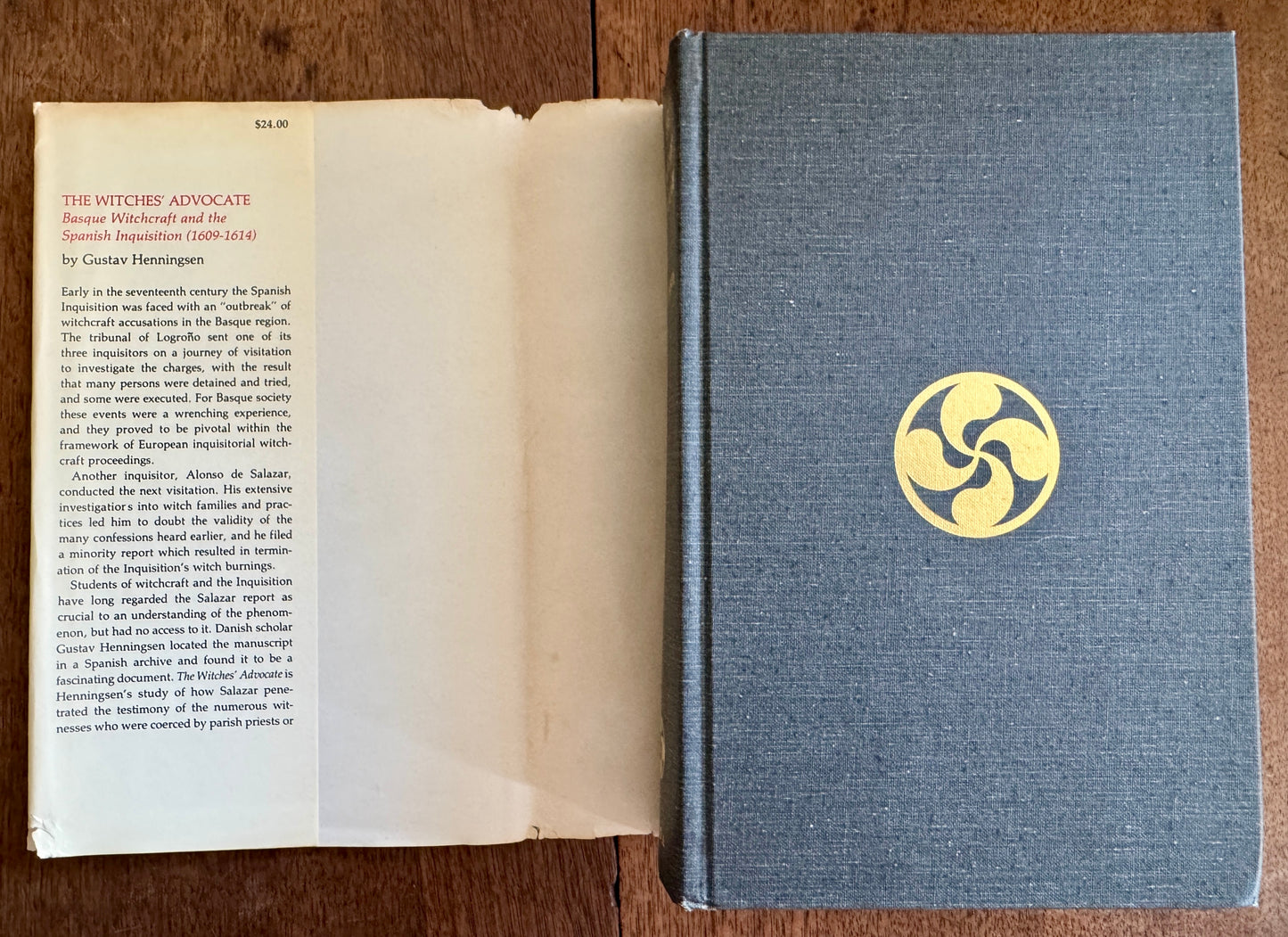


Henningsen, Gustav.
The Witches' Advocate: Basque Witchcraft and the Spanish Inquisition, (1609-1614)
The Witches' Advocate: Basque Witchcraft and the Spanish Inquisition, (1609-1614)
Couldn't load pickup availability
Reno: University of Nevada Press, 1980. First ed., first printing (full number line). xxxii, 607 pages: illustrations; 23 cm.. Includes bibliographical references (pages 557-577) and index. Personal owner signature to front free dnpaper, else tight, clean and near fine thus, in a very good(-) partly edge-tattered jacket now in archival mylar. Hardcover. ISBN: 0874170567; 9780874170566
Henningsen, a folklorist at the Danish Folklore Archives, reconstructs from the Inquisition's own records — chiefly the *relaciones de causas* and Salazar correspondence in the Archivo Histórico Nacional — the largest witch panic in Spanish history, which began at Zugarramurdi in Navarre in 1609, spread through the Basque borderlands under the tribunal of Logroño, and culminated in the auto-da-fé of 7–8 November 1610. Its central figure is the junior inquisitor Alonso de Salazar Frías, who during his 1611 visitation with the Edict of Grace gathered nearly 1,800 confessions and, in reports that anatomized the mechanics of rumor, suggestion, and coerced testimony, concluded that "there were neither witches nor bewitched until they were talked and written about" — an argument that persuaded the Suprema to issue the restrictive instructions of 1614 that effectively ended witch executions in Spain a generation before the northern European persecutions peaked. Methodologically the book is notable for combining archival-institutional history with the quantitative and folkloristic analysis of confession narratives, treating the depositions as evidence for popular belief and for the dynamics of a panic rather than for a cult; it thereby became a standard rebuttal both to Murray-style survivalist readings of the sabbat and to the Black Legend view of the Inquisition as uniformly credulous, while establishing the Spanish tribunals as skeptical outliers in the European witch trials. Long the fullest study of the Basque episode in English, it remains foundational for work on inquisitorial procedure, the sociology of witch panics, and Basque religious culture; it is best used alongside the author's companion edition, *The Salazar Documents* (Leiden: Brill, 2004), which prints the underlying sources in translation. Recommended for research collections in early modern European history, the history of witchcraft, Iberian and Basque studies, and folklore. | Witchcraft — Spain — Basque Provinces — History — 17th century. Inquisition — Spain. Salazar Frías, Alonso de. Trials (Witchcraft) — Spain — Logroño. Navarre — Religious life and customs.Sources: [American Historical Review review record](https://academic.oup.com/ahr/article-abstract/88/3/692/91540) · [Wellcome Collection catalog](https://wellcomecollection.org/works/s528awtv) · [Internet Archive](https://archive.org/details/witchesadvocateb0000henn) · [The Salazar Documents (Brill)] | Chapters: "The witches' advocate" referencia al inquisidor Alonso de SalazarWitchcraft -- Spain -- País Vasco. Witchcraft -- history Inquisition -- Pays basque (Espagne et France) Sorcellerie -- Espagne -- Pays basque espagnol. Inquisition -- Espagne -- Pays basque espagnol. Inquisition Witchcraft Witchcraft -- Spain -- País Vasco Inquistion -- Spain -- País Vasco Hexenglaube Hexenprozess Inquisition Inquisitie. Hekserij. Inquisition -- Spain -- Pais Vasco. Witchcraft -- Spain -- Pais Vasco. Inquisition -- Pays basque -- 17e siècle. Sorcellerie -- Procès -- Pays basque -- 17e siècle. Sorcellerie -- Pays basque -- 17e siècle. Named Corp: Consejo de Inquisición (Spain) Time: Geschichte 1609-1614 Geographic: Spain -- País Vasco Baskenland Diözese Logroño Spanien
Share