

De Almeida, Guido Antonio
Sinn und Inhalt in der Genetischen Phanomenologie E. Husserls
Sinn und Inhalt in der Genetischen Phanomenologie E. Husserls
Couldn't load pickup availability
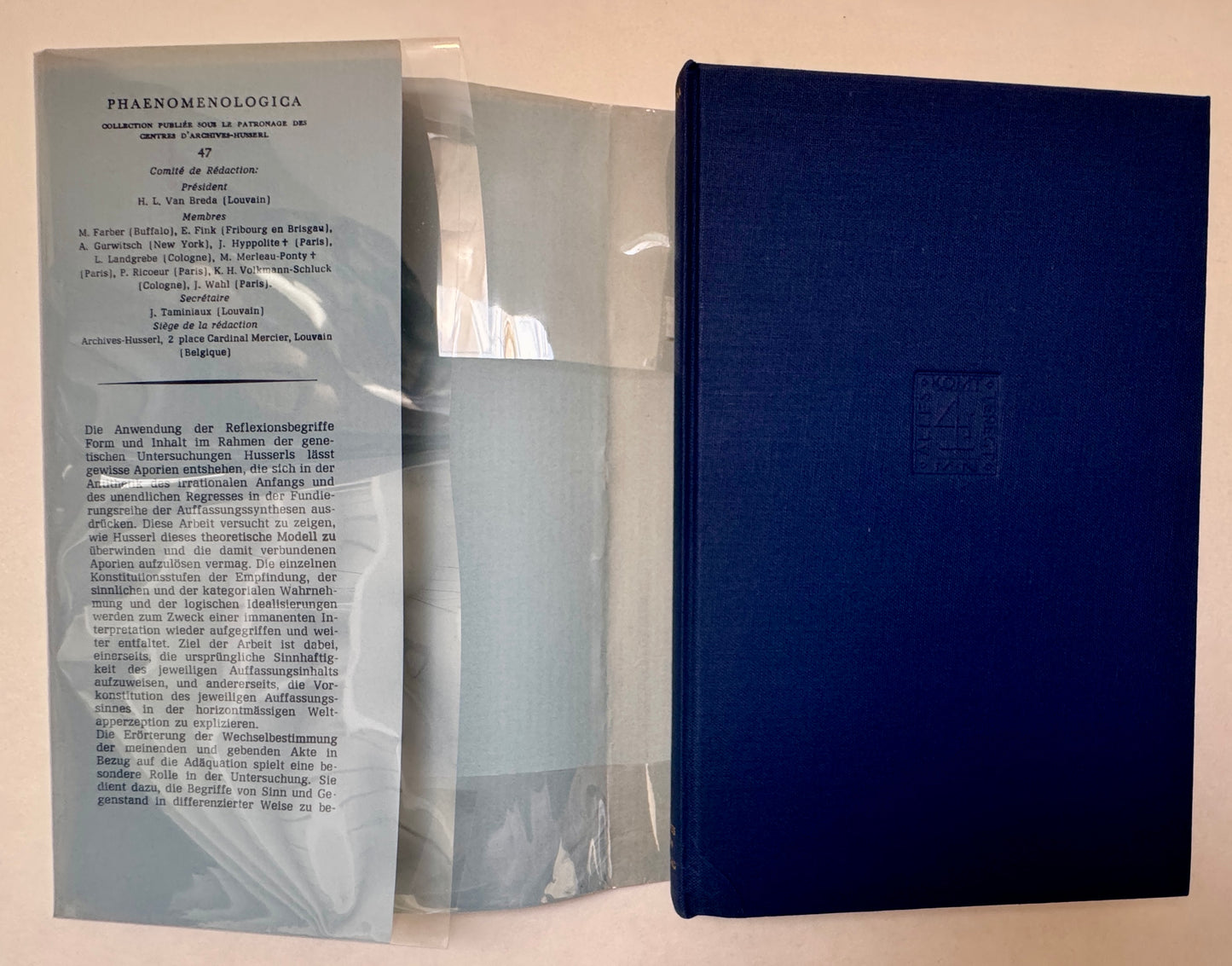
Den Haag: M. Nijhoff, 1972. Quarto in pale blue-grey jacket; x, 230 pages 25 cm Near fine+ in same jacket now in archival mylar. Gentle bump. Hardcover. ISBN: 9789024713189, 9024713188
In German. TItle translates as: Meaning and Content in Heusserl's Genetic Phenommenology.' // Contents [followed by English translation] § 1. Die "Reprasentationstheorie" und das Form-Inhalt-Modell. [The "Representation Theory" and the Form-Content Model.] § 2. "Statische" und "genetische" Phanomenologie. ["Static" and "Genetic" Phenomenology.] § 3. Aporetische Betrachtungen. [Aporetic Considerations.] § 4. Ursprung und Anfang. [Origin and Beginning.] § 5. Die Frage nach dem Sinn. [The Question of Sense.] § 6. Die Theorie der Horizontintentionalitat. [The Theory of Horizon Intentionality.] § 7. Gliederung der Arbeit. [Structure of the Work.] § 8. Husserls Definition der Empfindung. [Husserl's Definition of Sensation.] Erstes Kapitel: Die Frage der Empfindungskonstitution. [First Chapter: The Question of Sensation Constitution.] § 9. Die reine Hyletik. [Pure Hyletics.] § 10. Die Empfindungsfrage und der Weg zu ihrer Losung. [The Question of Sensation and the Path to its Solution.] § 11. Der Motivationszusammenhang zwischen sensueller "hyle" und gegenstandlichem Sinn. [The Motivational Connection between Sensual "hyle" and Objective Sense.] § 12. Kontinuitat und Diskontinuitat in der asthetischen Synthesis. [Continuity and Discontinuity in Aesthetic Synthesis.] § 13. Die sinnlichen Momente als Diskontinuitaten. [The Sensory Moments as Discontinuities.] § 14. Die neue phanomenologische Lehre der Affektion. [The New Phenomenological Doctrine of Affection.] § 15. Anmerkung zur Lokalisation der Empfindungen im Leibe. [Note on the Localization of Sensations in the Body.] Zweites Kapitel: Faktizitat und Sinnhaftigkeit der Sinnlichen Fulle. [Second Chapter: Facticity and Meaningfulness of Sensible Fullness.] § 16. Die doppelte Problematik der Sinnkonstitution. [The Double Problem of Sense Constitution.] § 17. Der Begriff der Sinnhaftigkeit des gegebenen Inhaltes in Husserls Ansatz. [The Concept of Meaningfulness of the Given Content in Husserl's Approach.] § 18. Der Sinn im Verhaltnis der adaquaten Erfullung. [Sense in Relation to Adequate Fulfillment.] § 19. Die Konstitution der Sinnhaftigkeit der sinnlichen Fulle in einem Moglichkeitsbewusstsein. [The Constitution of Meaningfulness of Sensible Fullness in a Consciousness of Possibility.] § 20. Sinnhaftigkeit und Faktizitat der sinnlichen Fulle. [Meaningfulness and Facticity of Sensible Fullness.] Drittes Kapitel: Die Sinnhaftigkeit der Kategorialen Formen. [Third Chapter: The Meaningfulness of Categorial Forms.] § 21. Die doppelte Weise der Gegenstandsbestimmung. [The Double Mode of Object Determination.] § 22. Unterscheidung zwischen kategorialer und sinnlicher Synthesis. [Distinction between Categorial and Sensible Synthesis.] § 23. Die Voraussetzungen des kategorialen Aktvollzuges. [The Prerequisites of Categorial Act Performance.] Viertes Kapitel: Die Idealitat der Logischen Gegenstandlichkeiten. [Fourth Chapter: The Ideality of Logical Objectivities.] § 24. Die "idealisierenden Voraussetzungen" der Logik. [The "Idealizing Presuppositions" of Logic.] § 25. Die Bestimmung des Begriffes des "Idealen". [The Determination of the Concept of the "Ideal".] § 26. Bestimmung des "Idealen" im Gegenzug zum "Faktischen". [Determination of the "Ideal" in Contrast to the "Factual".] § 27. Die Idealitat aller Gegenstandlichkeiten uberhaupt. [The Ideality of All Objectivities in General.] § 28. Die ideale Identitat als ein konstitutives Problem. [Ideal Identity as a Constitutive Problem.] § 29. Das Problem der "Wahrheit-an-sich" und Husserls Wahrheitsbegriffe. [The Problem of "Truth-in-itself" and Husserl's Concepts of Truth.] § 30. Die Idee der Wahrheit an sich als konstitutives Problem. [The Idea of Truth in Itself as a Constitutive Problem.] § 31. Die Idee der Wahrheit an sich und die "Horizontintentionalitat". [The Idea of Truth in Itself and "Horizon Intentionality".] § 32. Die Enthullung der idealisierenden Voraussetzungen der logischen Gegenstandlichkeiten. [The Uncovering of the Idealizing Presuppositions of Logical Objectivities.] § 33. Die Welt als "Idee" und als "Erfahrungsboden". [The World as "Idea" and as "Foundation of Experience".] Schlusswort. [Conclusion.] Beilage. Husserls "Transzendentale Asthetik": Weltontologie Oder Hermeneutik der Vorpradikativ Erfahrenen Welt? [Appendix. Husserl's "Transcendental Aesthetic": World Ontology or Hermeneutics of the Pre-predicatively Experienced World?] § 1. Der Begriff der transzendentalen Asthetik als Weltontologie. [The Concept of Transcendental Aesthetic as World Ontology.] § 2. Husserls Begriff der reinen Erfahrung. [Husserl's Concept of Pure Experience.] § 3. Die transzendentale Asthetik als Weltontologie: der "struktural-analytische" Ansatz. [Transcendental Aesthetic as World Ontology: The "Structural-Analytical" Approach.] § 4. Transzendentale Asthetik und genetische Phanomenologie. [Transcendental Aesthetic and Genetic Phenomenology.] Verwendete Abkurzungen. [Abbreviations Used.]
Share