
Quine, W. V.
Set Theory and Its Logic
Set Theory and Its Logic
Couldn't load pickup availability
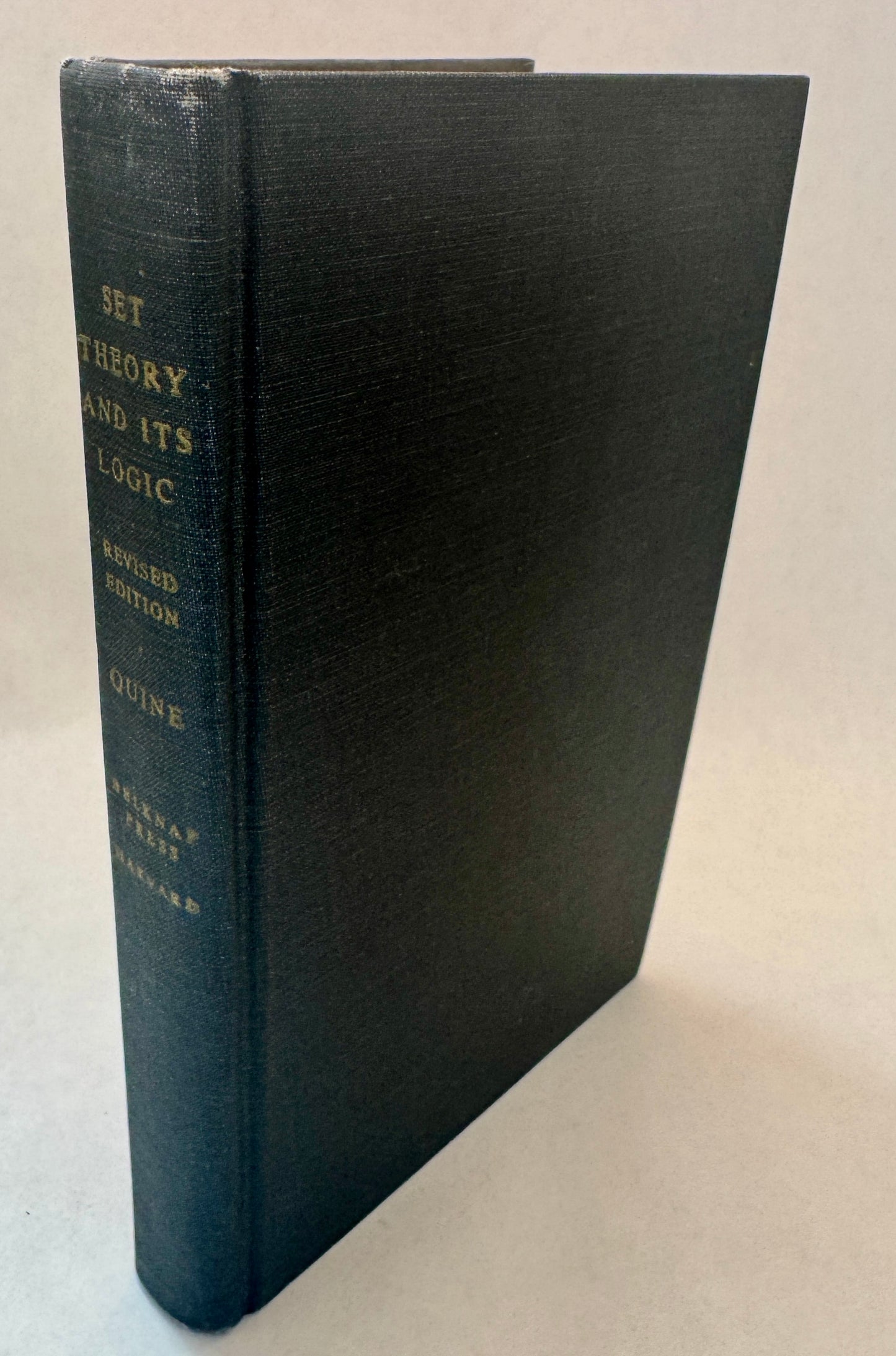
Mass.: Belknap Press of Harvard University Press, Cambridge, 1969. Rev. ed. xvii, 361 pages Binding slightly cocked; board edges a bit rubbed; small personal owner name to foront free enedpaper; else tight clean and overall very good to VG(+). See photos. Hardcover.
This is an extensively revised edition of Quine's introduction to abstract set theory and to various axiomatic systematizations of the subject. The treatment of ordinal numbers has been strengthened and much simplified, especially in the theory of transfinite recursions, by adding an axiom and reworking the proofs. Infinite cardinals are treated anew in clearer and fuller terms than before. Improvements have been made all through the book; in various instances a proof has been shortened, a theorem strengthened, a space-saving lemma inserted, an obscurity clarified, an error corrected, a historical omission supplied, or a new event notedcontents: Preface to the revised edition. Preface to the first edition. Contents. Introduction. Part one. The elements. I. Logic. 1. Quantification and identity. 2. Virtual classes. 3. Virtual relations. Ii. Real classes. 4. Reality, extensionality, and the individual. 5. The virtual amid the real. 6. Identity and substitution. Iii. Classes of classes. 7. Unit classes. 8. Unions, intersections, descriptions. 9. Relations as classes of pairs. 10. Functions. Iv. Natural numbers. 11. Numbers unconstrued 12. Numbers construed13. Induction. V. Iteration and arithmetic. 14. Sequences and iterates. 15. The ancestral. 16. Sum, product, power. Part two. Higher forms of number. Vi. Real numbers. 17. Program. Numerical pairs. 18. Ratios and reais construed. 19. Existential needs. Operations and extensions. Vii. Order and ordinals. 20. Transfinite induction. 21. Order. 22. Ordinal numbers. 23. Laws of ordinals. 24. The order of the ordinals. Viii. Transfinite recursion. 25. Transfinite recursion 26. Laws of transfinite recursion27. Enumeration. Ix. Cardinal numbers. 28. Comparative size of classes. 29. The schrãœder-bernstein theorem. 30. Infinite cardinal numbers. X. The axiom of choice. 31. Selections and selectors. 32. Further equivalents of the axiom. 33. The place of the axiom. Part three. Axiom systems. Xi. Russellâ€?S theory of types. 34. The constructive part. 35. Classes and the axiom of reducibility. 36. The modern theory of types. Xii. General variables and zermelo 37. The theory of types with general variables38. Cumulative types and zermelo. 39. Axioms of infinity and others. Xiii. Stratification and ultimate classes. 40. €œnew foundationsâ€?. 41. Non-cantorian classes. Induction again. 42. Ultimate classes added. Xiv. Von neumannâ€?S system and others. 43. The von neumannâ€?Bernays system. 44. Departures and comparisons. 45. Strength of systems. Synopsis of five axiom systems. List of numbered formulas. Bibliographical references. Index.
Share