

Mallarmé, Stéphane, 1842-1898, Author. Mondor, Henri, Annotater Jean-Aubry, G., Annotater
Œuvres Complètes [Oeuvres completes)
Œuvres Complètes [Oeuvres completes)
Couldn't load pickup availability
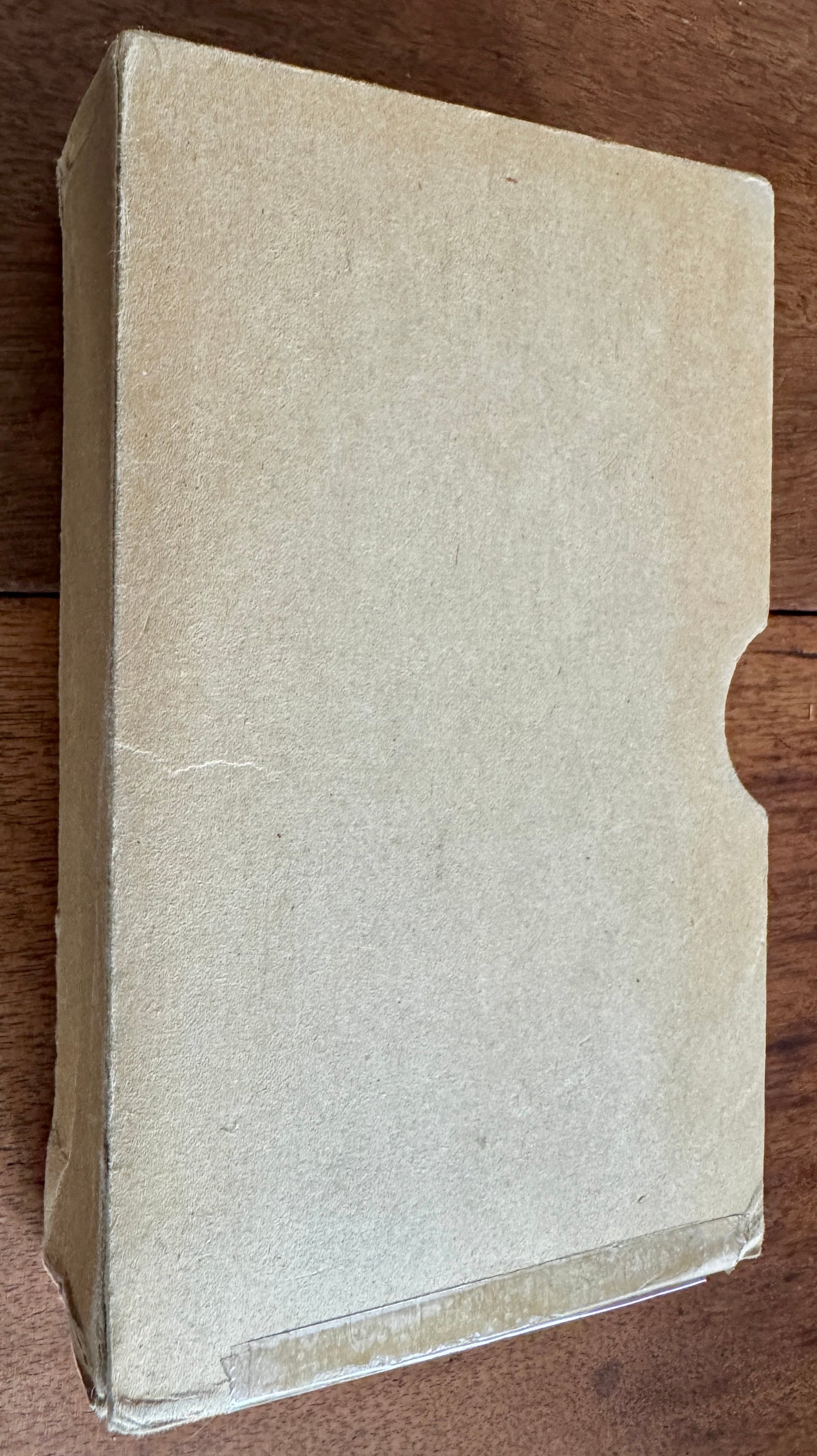
Paris: Gallimard, 1945 (1974). 1974 edition. Small octavo, dark green polished leather with gilt to spine; xxv, 1653 p. 18 cm.. "Bibliographie": p. [1323]-1369. India paper. In original thick mylar. Original slipcase. minor discoloraton to jacket p[anelws; a new few crack and chips to acetate jacket spine; else fine. Slipcase taped at bottom; very tender and parlty cracked at seams. . Hardcover. ISBN: 2070103269; 9782070103263
In French. Bibliothèque de la Pléiade; 65. [series]. No ISBN present in this 1974 printing. | Poetry, Modern -- 19th century -- Correspondence. Criticism -- France -- Literary style -- 19th century -- Correspondence. French literature -- 19th century. Littérature française -- 19e siècle. Littérature française -- 19e siècle -- Correspondance. Poésie -- 19e siècle -- Correspondance. Critique -- France -- Style -- 19e siècle -- Correspondance. French literature Gedichten. ¶ "Mallarmé (1842–1898) spent his life as an underpaid English teacher in provincial lycées and then Paris, writing very little and revising it forever — the collected poems fit in a thin volume. His project was to purify verse of the merely referential: to *"céder l'initiative aux mots,"* to yield the initiative to words, so that a poem produces "l'absente de tous bouquets," the flower absent from every bouquet, rather than pointing at a real one. The syntax dislocates, subordinate clauses hang unresolved, and the reader assembles meaning from suspension rather than statement. He hosted the Tuesday evenings on the rue de Rome where Valéry, Gide, and Yeats came to listen; he translated Poe; he wrote fashion copy under female pseudonyms for a magazine he produced almost single-handedly. His last work, *Un coup de dés jamais n'abolira le hasard* (1897), scattered type across the double-page spread in varying sizes and positions, treating white space as silence and the page itself as a scored surface — a gesture that skipped past his own century and landed in Apollinaire, concrete poetry, Broodthaers, and most typographic experiment since. He died the next year, having instructed his family to burn his notes for the never-written *Livre*, the total Book toward which he thought all earthly existence was meant to tend." —Claude (via
Share