

Guevara, Ernesto Che
Lettere, Diari e Scritti
Lettere, Diari e Scritti
Couldn't load pickup availability
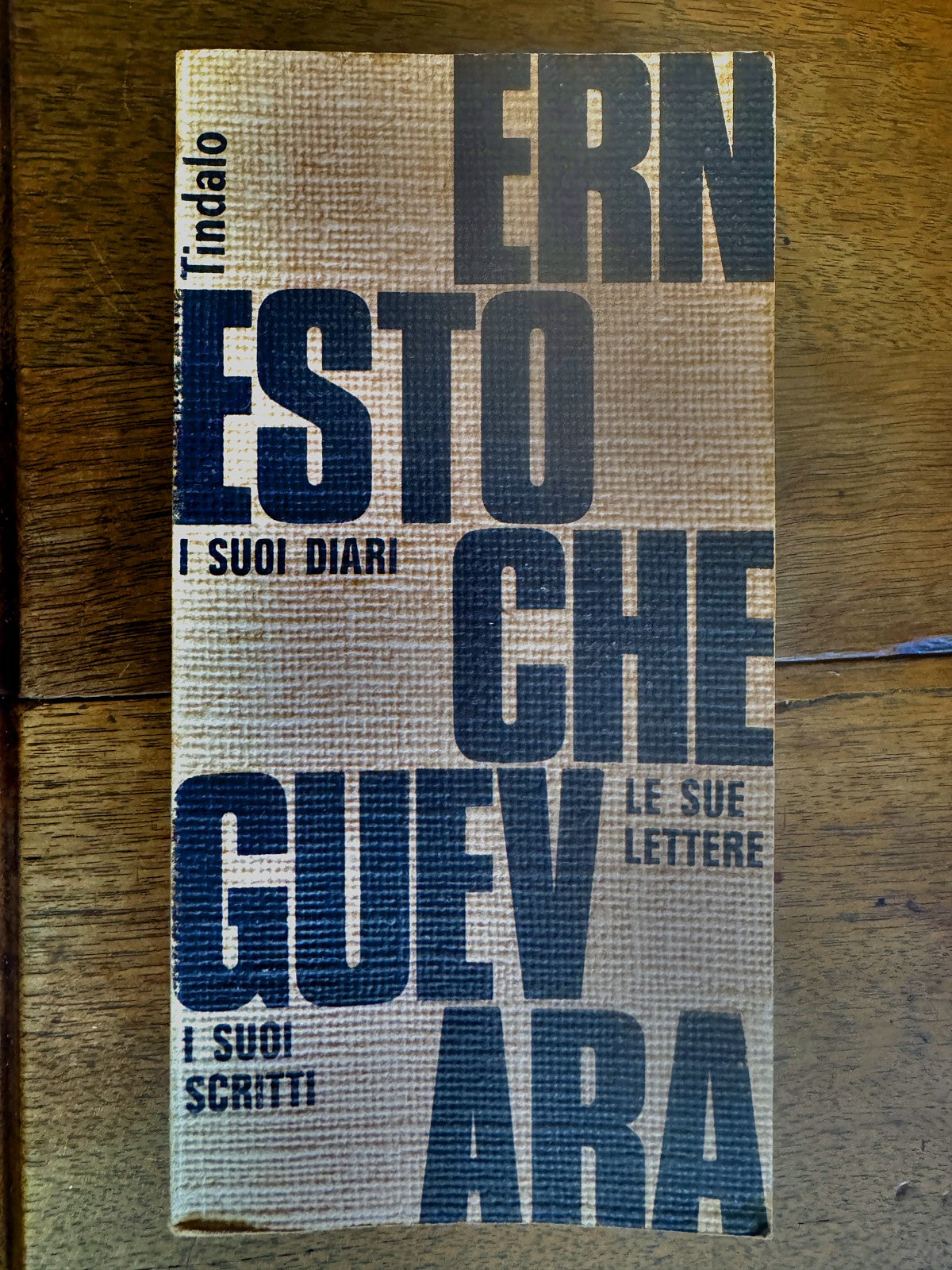
[Roma]: Tindalo, 1967. I edizione: ottobre 1967. Small, narrow octavo in original printed wraps; 419p.; 18cm. A remarkably crisp, near fine(+) copy, with very sparse foxing to front free endpaper corner, and top edge and fore-edge. A handsomely designed, unusally narrow paperback.
In Italian. Uncommon. Six of Guevara's texts and a four-page unsigned note, gathered in Rome and dated on the copyright page "I edizione: ottobre 1967" — the month he was captured and shot in Bolivia, on the 8th and 9th. Texts run from the guerrilla manual of 1960 (Guerra di bande, some 180 pages of how a small irregular force organises, moves, arms itself and turns terrain and the sympathy of country people into military advantage) through the Cuban campaign memoir of 1963 (Nella Sierra con Fidel — the "diari" of the title), the 1965 essay arguing that a revolution must produce a new kind of person and not merely a new economy (Il socialismo e l'uomo), and the April 1967 message to the Tricontinental calling for new fronts to be opened against the United States (Creare più Vietnam), to the two farewell letters of 1965: to Castro, renouncing his offices, his rank and his Cuban citizenship, and to his parents, on the final leaf. A 419-page translation cannot be commissioned, rendered and set in three weeks, so the book was made while he was alive and missing — he had vanished from public view in the spring of 1965 — and nothing in it acknowledges that he had died: no notice, no inserted leaf, nothing added to the Nota. The only death in the volume is the one he foresees himself, closing it: "death is logically possible", "this letter, perhaps, will be the last". That date fixes its place. The Bolivian diary, around which every later collection of Guevara's writings is arranged, appeared only in June 1968; Feltrinelli's four-volume Opere began in October 1968; the Sierra memoir reached English in 1968, and no English collection of comparable scope preceded this one. The translators, Pietro Mendoza and Ignazio Delogu, are the only names the book carries — no editor is credited and the selection goes unattributed — and Delogu (1928–2011), Sardinian poet and professor of Spanish literature, knew Guevara personally and went on translating and editing him for four decades, returning in 2005 to the same campaign narrative he first put into Italian here.
Share