

Welchman, John C.
Invisible Colors: A Visual History of Titles
Invisible Colors: A Visual History of Titles
Couldn't load pickup availability
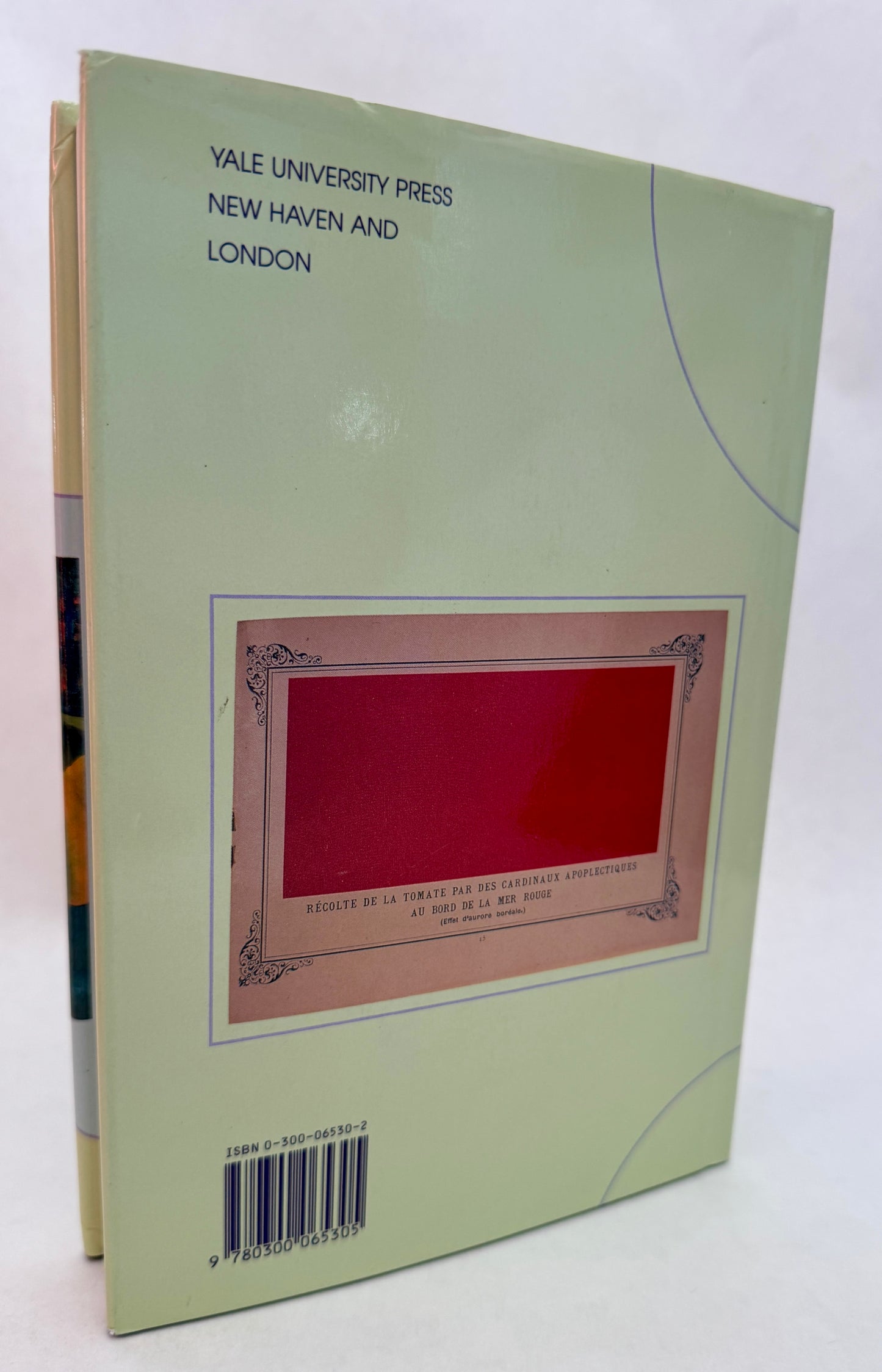
New Haven, CT: Yale University Press, 1997. First Edition (presumed; no prior editions or printings cited). Large octavo with blue boards and blue endpapers in light green and blue pictorial jacket; x, 452 pages: illustrations; 24 cm Near fine with mild external wear in near fine jacket, now in archival mylar. Hardcover. ISBN: 9780300065305, 0300065302
"In one of his sparkling aphorisms on the end of 'optical' art, Marcel Duchamp suggested that the title of an artwork was an 'invisible color'. John Welchman now offers the first critical history of how and why modern artworks receive their titles. He shows that titles were seldom produced and can rarely be understood outside of the institutional parameters that made them visible - exhibitions, criticism, catalogues, and even national politics." -Jacket copy
Contents: Introduction. Titles and the history of art: beginnings; Theories of titling and naming. Reckoning with the title and its sites. Poetic intensity and social extension: expanded fields for the title; Zero names: "absences and over-nourishing signs"; Titular transformations: "beyond recognition". Monet and the development of a nominative effectualism. "Explanations," poems, and "real allegory"; Claude Monet: "A succession of astonishing effects". Symbolism I: Redon, Gauguin, Signac. Introduction: Titles, institutions, and analogues; Odilon Redon: "vagueness, indeterminacy, equivocation"; Paul Gauguin: "not a title, but a signature"; Paul Signac and Alphonse Allais: exhibitions, numbers, and "incoherents". Symbolism II: James McNeill Whistler: the elaboration and contraction of the title. Nominalist order and disorder: form, violence, and revisionism. Paul Cézanne: "do not remain a creature without a name"; Cubic language and the philosophical brothel; Suprematism, Unovis, and "5 x 5 = 25". Composition I: naming the non-iconic in the work of Piet Mondrian and Wassily Kandinsky. Piet Mondrian: "it is above all composition that must suppress the individual; Life and death sentences: compositional theory in Matisse, Malevich, and the United States; Wassily Kandinsky: "reason, the conscious, the deliberate, and the purposeful". Dada and surrealism: alchemies of the word. Max Ernst: titles and the "no longer" of painting; Marcel Duchamp: "prime words" and inscriptions; Francis Picabia: names, bodies, diagrams, and counter-identities; Notes on surrealist titling: Magritte, Miró, Tanguy, Matta. Composition II: sounds, silences, and "cognitive naming". Towards a genealogy of the counter-composition; Abstract expressionism: "something[s] extra"; Neo-Dada, assemblage, happenings: making "in spite of composition"; Tropic writing: rethinking the titular metaphors of late modernism; Conclusion: titles after composition. "Labelless labels": notes on the postmodern title. Switching from the 1960s: Smithson, Morris, and conceptual art; Naming through institutions and expressions; "On the other side of the proper name": untitling, anonymity, gender, and power. Epilogue: "A museum of language in the vicinity of art.". // **Somewhat heavy item. Additional shipping fees may be needed for expedited or international orders. Please inquire**
Share