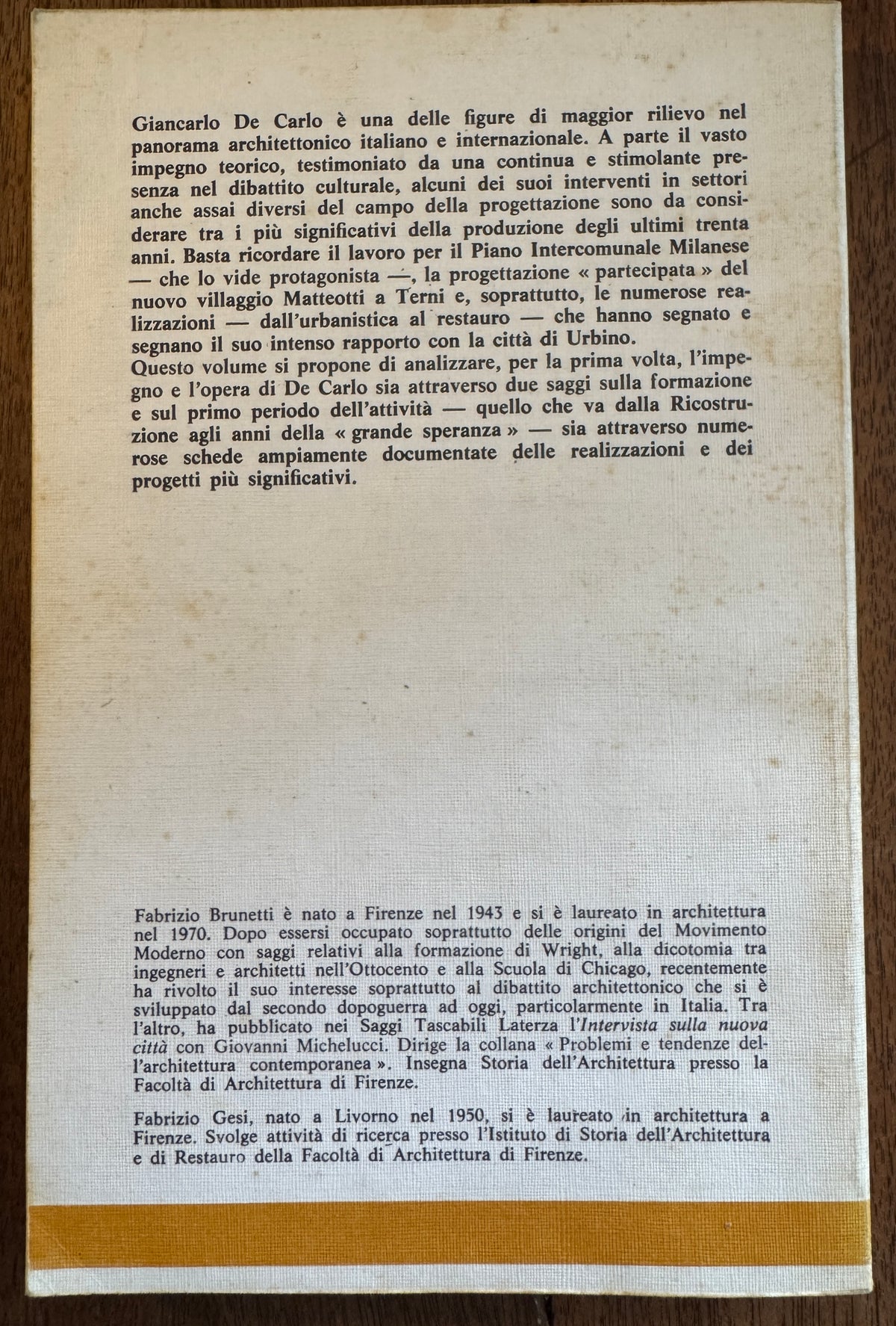


Brunetti, Fabrizio; Gesi, Fabrizio
Giancarlo de Carlo
Giancarlo de Carlo
Couldn't load pickup availability
Firenze: Alinea, 1981. 239 pages: illustrations; 21 cm; bibliographical references (pages 221-230) and index. Sewn, Mild foxing to exterior and prelims; spine slightly rolled; overall very good. Binding is tight; leaves clean. Paperback.
In Italian. Uncommon in North America. Well-illustrated in black and white (photos and architectural drawings). Architettura e città; 6. [series]. ¶ Genoese-born architect, planner and theorist, a central dissenting voice in postwar Italian modernism. Trained first in engineering at the Politecnico di Milano (1943), then in architecture at Venice (1949), after wartime service with the anti-fascist Resistance and lasting ties to the anarchist movement. Early member of Team 10, the group that broke with the Congrès Internationaux d’Architecture Moderne (CIAM) over its rigid functionalism. Best known for half a century of work at Urbino: the general plan for the historic city, the hillside Collegi Universitari, and the Faculty of Education, threaded into the medieval fabric rather than set against it. The Villaggio Matteotti workers’ housing at Terni (1969–74) put into practice his case for participatory design, where future residents shape the scheme. That case was argued in his lecture “An Architecture of Participation” (1972). Founder of the International Laboratory of Architecture and Urban Design (ILAUD, 1976) and longtime editor of the journal Spazio e Società. Professor at the Istituto Universitario di Architettura di Venezia (IUAV) and at Genoa. Royal Institute of British Architects (RIBA) Royal Gold Medal, 1993.
Share