

Van Helsing, Jan (pseud., Jan Udo Holey)
Geheim Gesellschaften (Geheimgesellschaften) Und Ihre Macht Im 20. Jahrhundert; Oder Wie Die Welt Nicht Regiert
Geheim Gesellschaften (Geheimgesellschaften) Und Ihre Macht Im 20. Jahrhundert; Oder Wie Die Welt Nicht Regiert
Couldn't load pickup availability
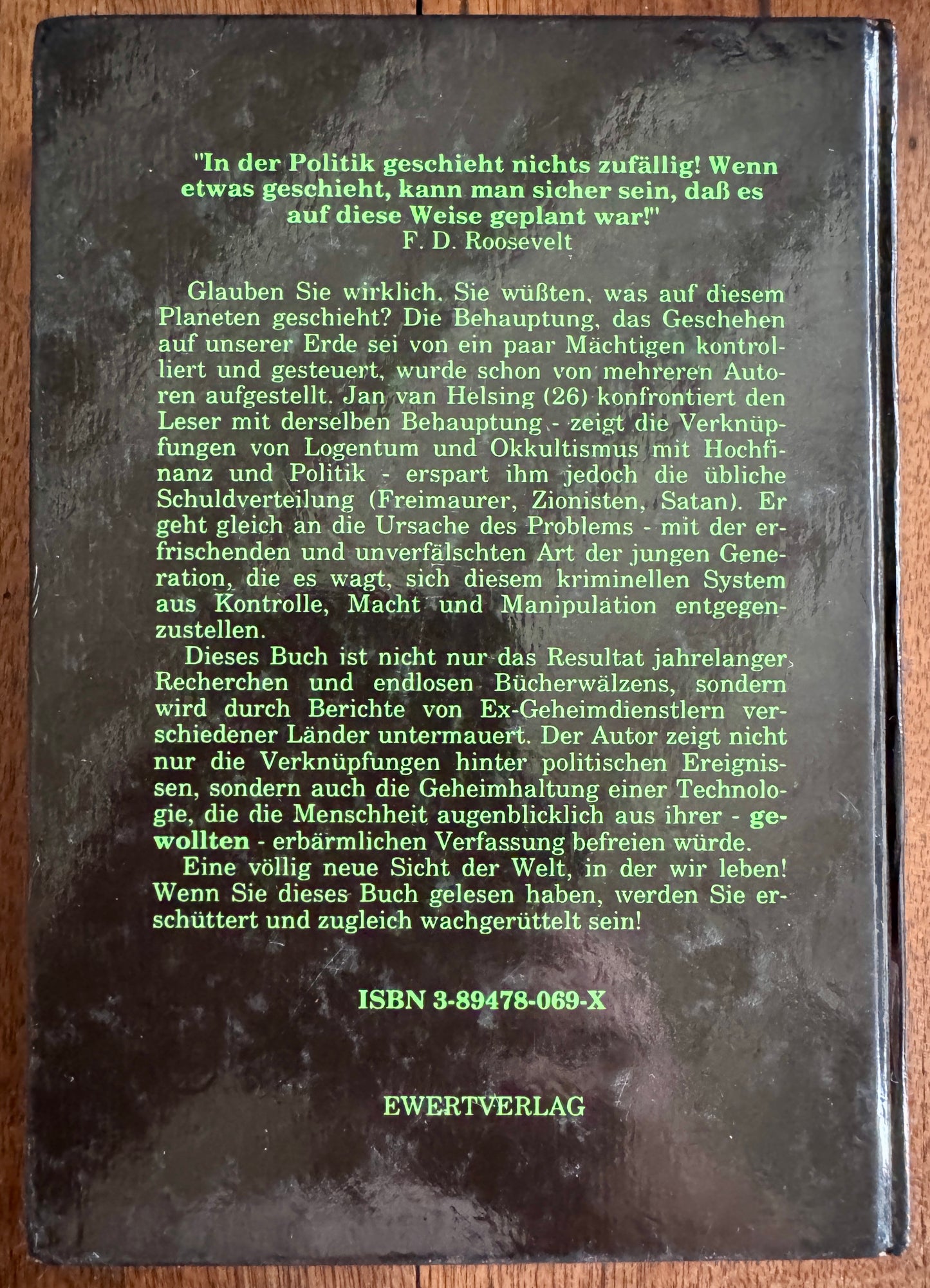
Gran Canaria: Ewertverlag, 1995. Small quarto in glossy black & red boards; 352pp, b&w illus, ads. Very good+ to near fine(-); tight and clean. Hardcover. ISBN: 389478069x
In German. Uncommon in US. Title translates roughly as: Secret Societies and Their Power in the 20th Century; or, How the World Is Not Governed. "Jan Udo Holey was twenty-six when he published this title under the borrowed name of Bram Stoker's vampire hunter, and the book's commercial success — over 100,000 copies before the courts intervened — had less to do with its arguments than with its packaging. It arrived in 1993–94 through Ewertverlag as New Age literature: chatty, first-person, unfootnoted where it mattered and over-footnoted where it didn't, sold in esoteric shops beside books on crystals and past lives. What it actually did was launder the *Protocols of the Elders of Zion* into that idiom. The structure is the standard chain — Freemasonry to the Illuminati to the Bilderbergers, Trilateral Commission, CFR and UN — but the chain terminates where such chains historically terminate, and Holey reached for Holocaust-denial authors to get there. The German constitutional-protection agencies' term for him, *rechtsextremer Esoteriker*, is precise: the interest of the book is that it demonstrates how frictionlessly interwar antisemitic conspiracism could be re-dressed in the vocabulary of the alternative-spirituality market, addressed to readers who would have rejected the same content in *völkisch* packaging. The Mannheim Jewish Community brought incitement charges in 1996; both volumes were seized and indexed in Germany and Switzerland; the prosecution collapsed on procedural grounds in 1998 and the seizure was lifted in 2001, though the indexing stands. It survives as a document of a transmission mechanism rather than as a text worth arguing with — which is roughly the terms on which it belongs in a catalogue, if it belongs in one." — Claude
Share