

Feferman, Anita Burdman; Feferman, Solomon
Alfred Tarski: Life and Logic
Alfred Tarski: Life and Logic
Couldn't load pickup availability
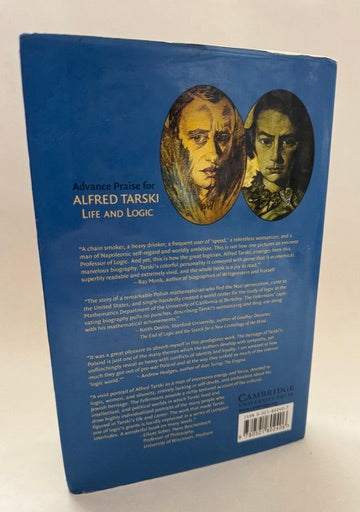
Cambridge, UK: Cambridge University Press, 2004. First Edition. Large octavo in blue cloth boards in blue and yellow pictorial jacket; vi, 425 pages: illustrations; 24 cm Very good (+) clean and tight with mild bumping to corners; in very good (-) to good (++) jacket showing some edgewear and sparse chipping; dampstains at corners (please see photos). Hardcover. ISBN: 0521802407
Alfred Tarski, one of the greatest logicians of all time, is widely thought of as "the man who defined truth." His mathematical work on the concepts of truth and logical consequence are cornerstones of modern logic, influencing developments in philosophy, linguistics and computer science. Tarski was a charismatic teacher and zealous promoter of his view of logic as the foundation of all rational thought, as well as a bon-vivant and a womanizer, who played the "great man" to the hilt. Born in Warsaw in 1901 to Jewish parents, he changed his name and converted to Catholicism, but was never able to obtain a professorship in his home country. A fortuitous trip to the United States at the outbreak of World War 1 saved his life and turned his career around, even though it separated him from his family for years. By the war's end, Tarski was established as a professor of mathematics at the University of California, Berkeley, where he started a department in logic and methodology that attracted students and distinguished researchers from all over the world. From the cafes of Warsaw and Vienna to the mountains and deserts of California, this first full- length biography places Tarski in the social, intellectual and historical context of his times. It presents a vivid picture of a personally and professionally passionate man, interlaced with an account of his major scientific achievementsContents: The two Tarskis. Independence and university. Interlude I: The Banach-Tarski paradox, set theory and the axiom of choice. Polot! The Polish attribute. Interlude II: The completeness and decidability of algebra and geometry. A wider sphere of influence. Interlude III: Truth and definability. How the 'unity of science' saved Tarski's Life. Berkeley is so far from Princeton. Building a school. Interlude IV: The Publication Campaigns. 'Papa Tarski' and his students. Three meetings and two departures. Logic and methodology, center stage. Heydays. Interlude V: Model theory and the 1963 Symposium. Around the world. Los Angeles and Berkeley. Interlude VI: Algebras of logic. A decade of honors. The last times.
Share