

Walbank, F. W.
A Historical Commentary on Polybius
A Historical Commentary on Polybius
Couldn't load pickup availability
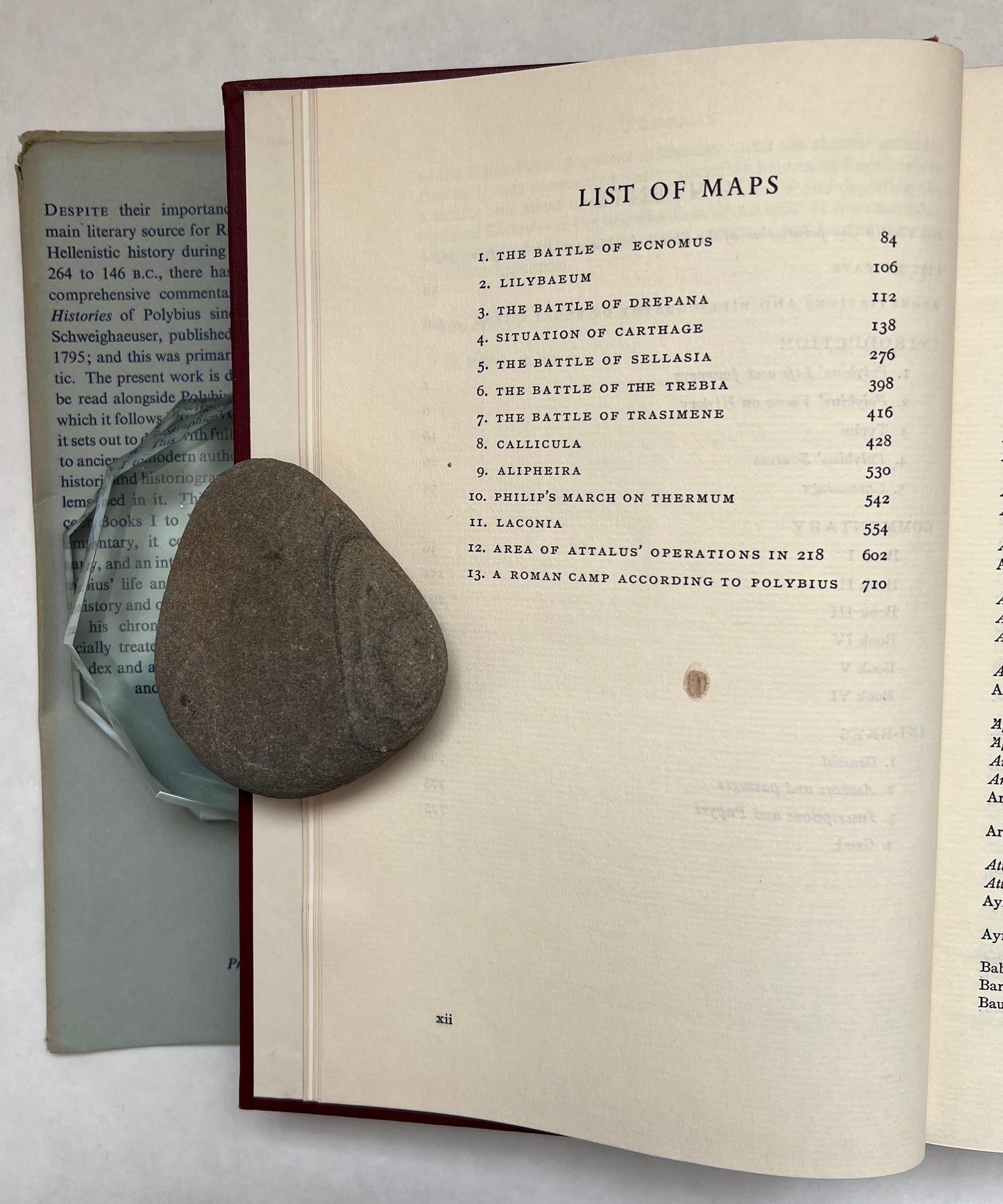
Oxford: Clarendon Press, 1957. Later printing. Octavo in red boards, gilt titles to spine; dust jacket; 775 pp: illustrations (b&w), maps, index; 23 cm About near fine to near fine(-) in very good dust jacket; mild bumping to top and tail of spine; small stain to a few early pages (see photos); else pages crisp and clean; binding tight; dust jacket shows closed tear to upper left corner, slight fading to jacket, dust jacket is protected in archival mylar. Hardcover.
**Volume 1 only** / Contents: v. 1. Commentary on books i-vi | Index | Reprinted from corrected sheets of first edition.| Polybius (c. 200–118 BCE) stands as one of antiquity’s most exacting historians, a Greek statesman from Megalopolis whose enforced residence in Rome after the Achaean defeat sharpened his insight into power, institutions, and causation. In his Histories, conceived to explain Rome’s astonishing rise to Mediterranean supremacy, he rejected mythic ornament and rhetorical flourish in favor of autopsy, eyewitness testimony, and pragmatic analysis, insisting that history be written for statesmen rather than for delight. His celebrated theory of anacyclosis—the cyclical degeneration of constitutions—and his admiration for the Roman mixed constitution fuse Greek political philosophy with hard Roman practice, while his stern rebukes of careless predecessors establish an enduring standard of methodological rigor. More than a chronicler of events, Polybius articulated a philosophy of history grounded in necessity, fortune, and human agency, making him a crucial bridge between classical Greek thought and the sober realism of Roman historiography.
Share